Leadership has always been one of the defining factors behind successful organizations, but its meaning has changed significantly over the past decade. In today’s business environment, the leadership qualities that matter most go far beyond supervising operations or making strategic decisions. They must inspire confidence, encourage innovation, build resilient teams, and guide organizations through constant change. Rapid technological advancements, shifting customer expectations, economic uncertainty, and global competition have transformed leadership into a dynamic skill that requires continuous learning and adaptability.
Organizations across the United States are operating in increasingly complex environments where traditional management approaches are no longer enough. Employees expect transparent communication, customers value authenticity, and businesses must respond quickly to evolving market conditions. These changes have highlighted the importance of leaders who can balance strategic thinking with emotional intelligence while maintaining a clear vision for long-term success.
Strong leadership is no longer measured solely by financial performance or organizational growth. It is equally reflected in the ability to create a positive workplace culture, build trust among stakeholders, encourage collaboration, and make decisions that benefit both the organization and the people who contribute to its success. Businesses that invest in developing these leadership qualities often become more resilient, innovative, and prepared for future challenges.
Why Leadership Is Evolving
The business landscape today looks very different from what it did even a few years ago. Digital transformation has accelerated the pace of change across nearly every industry, while remote work, artificial intelligence, automation, and global connectivity have introduced new opportunities and challenges for organizations of every size.
Leaders can no longer rely on rigid management structures or traditional decision-making processes. Instead, they must remain flexible while responding to rapidly changing business conditions. Success increasingly depends on understanding people, encouraging collaboration, and creating environments where employees feel empowered to contribute their ideas.
Modern leadership also requires greater transparency. Employees appreciate leaders who communicate openly, explain organizational decisions, and acknowledge challenges honestly. Customers and business partners similarly expect organizations to operate with integrity and accountability. This growing emphasis on openness has transformed leadership into a relationship-driven responsibility rather than simply an executive position.
Organizations that embrace these changes often discover that effective leadership creates stronger employee engagement, better customer experiences, and more sustainable business growth.
Vision Provides Direction
Every successful organization begins with a clear vision. Leaders who understand where they want their businesses to go create confidence throughout the organization because employees know how their individual contributions support larger objectives.
Vision is more than setting ambitious goals. It involves understanding industry trends, recognizing future opportunities, and preparing organizations for changes before they become urgent. Effective leaders continuously evaluate market conditions while encouraging innovation that supports long-term development.
When employees understand the organization’s purpose, they become more motivated to contribute meaningful ideas and take ownership of their work. A clear vision also improves decision-making because every strategic choice can be evaluated according to whether it supports long-term objectives.
Businesses that consistently communicate their vision often experience greater alignment across departments, improved collaboration, and stronger organizational performance.
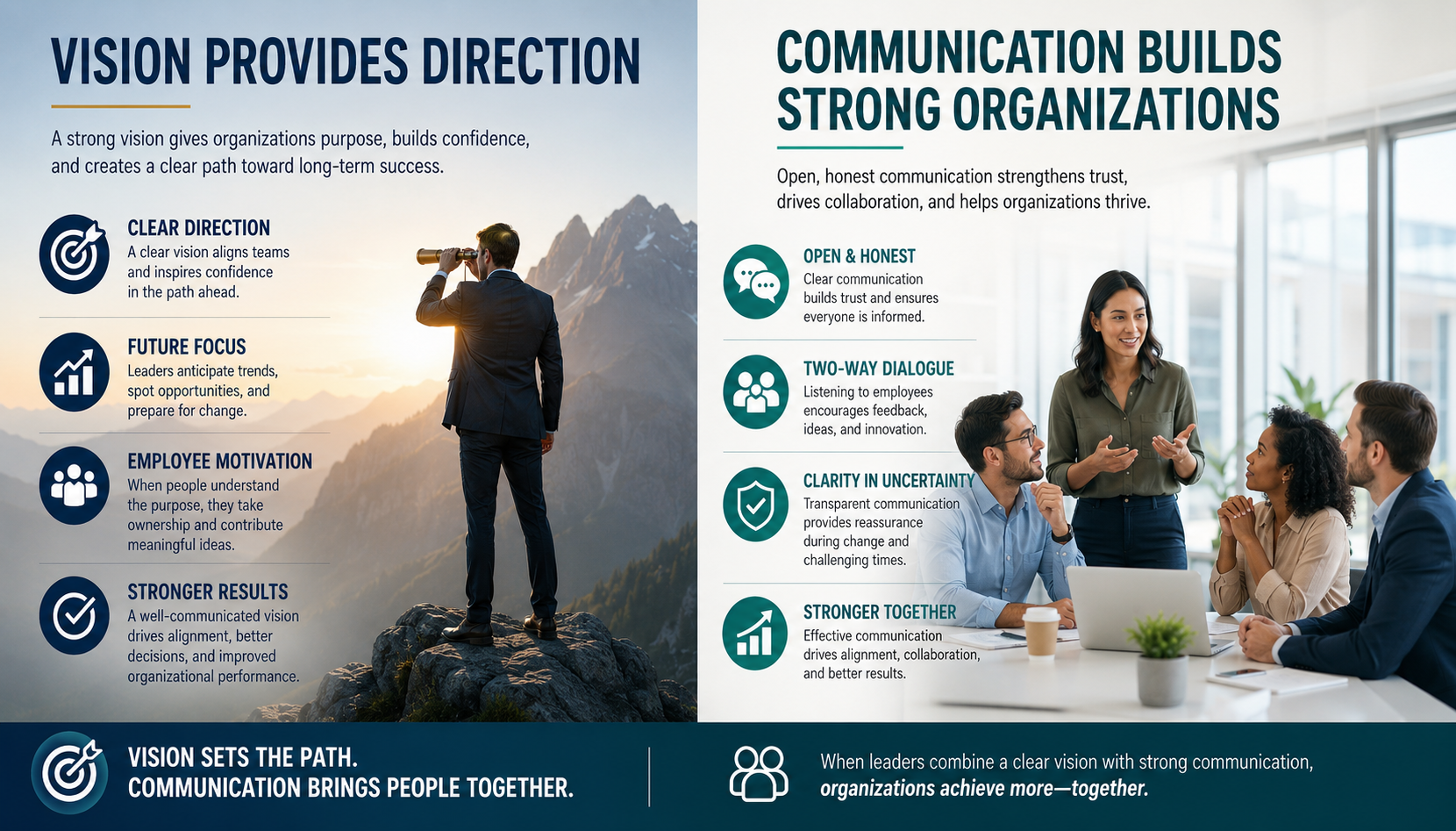
Communication Builds Strong Organizations
Communication remains one of the most important leadership skills in every industry. Even the most carefully designed business strategies can fail if employees do not clearly understand expectations, priorities, or organizational goals.
Strong leaders communicate frequently, honestly, and consistently. They listen carefully before making decisions and encourage feedback from employees at every level of the organization. This two-way communication builds trust while creating an environment where people feel comfortable sharing concerns, ideas, and innovative solutions.
Clear communication also becomes especially valuable during periods of uncertainty. Whether organizations are introducing new technologies, expanding into different markets, or responding to unexpected challenges, employees look to leadership for clarity and reassurance.
Leaders who explain changes thoughtfully while maintaining transparency help reduce confusion and encourage greater confidence throughout the organization.
Trust Is the Foundation of Leadership
Trust cannot be demanded; it must be earned through consistent actions over time. Employees naturally place greater confidence in leaders who demonstrate integrity, fairness, and accountability in their daily decision-making.
Organizations built on trust often experience stronger teamwork because employees feel respected and valued. Instead of focusing on internal politics or uncertainty, people devote more energy toward achieving shared objectives and solving business challenges collaboratively.
Trust also influences relationships outside the organization. Customers remain loyal to businesses they believe operate honestly, while suppliers and business partners prefer working with organizations known for reliability and professionalism.
Leaders strengthen trust by following through on commitments, acknowledging mistakes when necessary, and treating every stakeholder with respect. These consistent behaviors gradually create organizational cultures where collaboration becomes natural rather than forced.
Emotional Intelligence Has Become a Competitive Advantage
Technical expertise and business knowledge remain valuable leadership qualities, but emotional intelligence has become equally important. Leaders who understand how emotions influence workplace interactions often build stronger teams because they recognize individual strengths, communicate more effectively, and respond thoughtfully during difficult situations.
Emotional intelligence includes self-awareness, empathy, active listening, and the ability to manage conflict constructively. These skills help leaders understand different perspectives while encouraging respectful communication throughout the organization.
Employees who feel understood by leadership are generally more engaged and motivated. They are also more likely to contribute ideas, collaborate with colleagues, and remain committed during periods of organizational change.
As workplaces become increasingly diverse, emotional intelligence helps leaders create inclusive environments where every employee has opportunities to contribute and succeed.
Adaptability Defines Modern Leadership
One of the most significant characteristics of successful leaders is adaptability. Business environments rarely remain static, making flexibility essential for organizations seeking long-term success.
Adaptable leaders continuously learn, evaluate changing conditions, and adjust strategies without losing sight of their overall objectives. They recognize that uncertainty is an inevitable part of business and prepare their organizations accordingly.
Instead of resisting change, adaptable leaders encourage experimentation, continuous improvement, and thoughtful innovation. They understand that every challenge presents opportunities to learn, strengthen operations, and develop more effective business strategies.
Organizations guided by adaptable leadership often recover more quickly from disruptions because employees have already developed confidence in responding to changing circumstances.
Collaboration Creates Better Decisions
Leadership is no longer about making every decision independently. Modern organizations benefit when leaders encourage collaboration across departments, allowing employees with different expertise to contribute valuable insights.
Collaborative leadership creates stronger problem-solving because multiple perspectives often produce more balanced and practical solutions. It also strengthens employee engagement by demonstrating that individual contributions are respected regardless of position or experience.
Technology has made collaboration easier than ever before. Digital communication platforms, cloud-based project management systems, and virtual meetings allow organizations to share ideas across geographic boundaries while maintaining productive teamwork.
Leaders who embrace collaboration create cultures where innovation develops naturally because employees understand that thoughtful ideas are welcomed and appreciated.
Decision-Making During Uncertainty
One of the greatest responsibilities of any leader is making decisions when complete information is unavailable. Business environments rarely provide perfect conditions, and leaders often face situations where they must balance competing priorities while managing risks and maintaining organizational stability. Whether responding to economic fluctuations, technological disruption, or changing customer expectations, effective leaders remain calm under pressure and focus on making informed decisions rather than waiting for perfect certainty.
Successful decision-making begins with gathering reliable information from multiple sources. Leaders evaluate market trends, financial performance, customer feedback, and operational data before considering how each option aligns with the organization’s long-term objectives. They also encourage open discussions with experienced team members because different perspectives often reveal opportunities or challenges that might otherwise be overlooked. This collaborative approach improves decision quality while increasing employee confidence in leadership.
Equally important is the willingness to adjust when circumstances change. Strong leaders understand that flexibility is not a sign of weakness but a demonstration of strategic thinking. They monitor outcomes, learn from experience, and refine their approach whenever new information becomes available. Organizations led by adaptable decision-makers are generally better prepared to respond quickly while maintaining stability during periods of uncertainty.
Innovation Begins With Leadership
Innovation is frequently associated with new technology, but its foundation lies in leadership. Organizations become innovative when leaders create environments where employees feel encouraged to share ideas, experiment responsibly, and contribute creative solutions without fear of failure. Innovation is not a single event; it is a continuous process that develops through curiosity, collaboration, and a willingness to improve.
Leaders who support innovation invest in learning rather than simply focusing on immediate results. They encourage teams to question existing processes, identify inefficiencies, and explore better ways of achieving organizational goals. Even small improvements can create meaningful long-term advantages when organizations consistently seek opportunities for growth.
Innovation also depends on psychological safety. Employees are more likely to contribute valuable ideas when they know their opinions will be respected and evaluated fairly. Leaders who recognize effort, celebrate creative thinking, and treat mistakes as learning opportunities create cultures where innovation becomes part of everyday business operations instead of an occasional initiative.
Building High-Performing Teams
No organization succeeds because of one individual. Sustainable success depends on teams that communicate effectively, trust one another, and work toward shared objectives. Building these teams requires leadership that understands both organizational goals and individual strengths.
Effective leaders invest time in understanding the unique abilities of each employee. Rather than assigning identical responsibilities to everyone, they match individuals with roles where they can contribute most effectively while continuing to develop professionally. This approach increases productivity because employees perform work that aligns with their skills and interests.
High-performing teams also depend on clear expectations. Leaders establish measurable objectives while providing employees with the resources and guidance necessary to achieve them. Regular feedback, recognition, and professional development opportunities strengthen motivation while helping individuals continuously improve their performance.
Collaboration remains equally important. Teams that openly exchange ideas, solve problems together, and support one another often produce stronger outcomes than groups operating independently. Leaders who encourage cooperation instead of internal competition create healthier workplace cultures where collective success becomes a shared priority.
Accountability Strengthens Organizational Culture
Accountability is one of the defining characteristics of effective leadership because it establishes clear expectations while reinforcing responsibility throughout the organization. Employees naturally respect leaders who accept responsibility for their own decisions and encourage the same standard across every level of the business.
Accountability does not involve assigning blame when challenges arise. Instead, it focuses on learning from experience, addressing problems constructively, and identifying practical solutions that strengthen future performance. Organizations built on accountability respond more effectively to setbacks because individuals concentrate on improvement rather than avoiding responsibility.
Leaders also strengthen accountability through consistency. Policies, expectations, and organizational values should apply equally to everyone regardless of position. Fairness creates trust while encouraging employees to maintain high professional standards in their daily work.
When accountability becomes part of organizational culture, businesses experience stronger collaboration, improved operational efficiency, and greater confidence among employees, customers, and business partners.
Resilience Helps Organizations Navigate Change
Every organization eventually faces unexpected challenges. Economic downturns, technological disruption, supply chain interruptions, regulatory changes, and shifting customer preferences all require thoughtful leadership capable of maintaining stability during uncertain periods.
Resilient leaders prepare their organizations before challenges occur. They invest in risk management, encourage continuous learning, diversify business strategies, and build strong professional relationships that support long-term resilience. These proactive efforts allow organizations to recover more quickly because essential systems and partnerships are already in place.
Resilience also involves maintaining optimism without ignoring reality. Effective leaders communicate honestly about challenges while reinforcing confidence in the organization’s ability to overcome obstacles through teamwork, careful planning, and strategic decision-making.
Employees often look to leadership for reassurance during periods of uncertainty. Leaders who remain composed while communicating openly help reduce anxiety and encourage teams to remain focused on practical solutions rather than short-term concerns.
Leading Through Digital Transformation
Digital transformation has become one of the most significant influences on modern leadership. Artificial intelligence, cloud computing, automation, advanced analytics, and digital collaboration platforms continue changing how organizations operate, communicate, and compete.
Successful leaders understand that technology should support people rather than replace meaningful human interaction. They evaluate new technologies carefully, ensuring that digital investments improve productivity while strengthening employee experiences and customer satisfaction.
Digital transformation also requires continuous learning. Leaders encourage employees to develop new skills while providing opportunities for professional growth that prepare teams for future workplace demands. Organizations that combine technological advancement with workforce development often experience stronger long-term performance because employees remain confident and adaptable as industries evolve.
Leadership during digital transformation therefore involves balancing innovation with empathy, ensuring that organizational progress benefits both the business and the people contributing to its success.
Developing the Next Generation of Leaders
One of the most important responsibilities of today’s leaders is preparing future leaders who can guide organizations through the challenges of tomorrow. Leadership should never depend entirely on one individual because sustainable organizations are built through continuous learning, knowledge sharing, and professional development.
Successful businesses invest in mentoring programs, leadership training, and opportunities that allow employees to develop new skills through practical experience. Future leaders learn not only from formal education but also by observing how experienced professionals solve problems, communicate during difficult situations, and make strategic decisions.
Encouraging leadership development also improves employee engagement. Individuals who see opportunities for personal growth are generally more motivated to contribute their best work because they recognize that the organization values their long-term success. This investment strengthens retention while creating a stronger internal talent pipeline capable of supporting future business expansion.
Leadership development should begin long before employees reach senior management positions. Giving individuals opportunities to lead projects, collaborate across departments, and participate in strategic discussions helps them build confidence while developing practical decision-making skills that benefit both their careers and the organization.
Ethical Leadership Builds Lasting Trust
Ethics has become an increasingly important part of modern leadership because organizations operate in an environment where transparency and accountability influence reputation as much as financial performance. Customers, employees, investors, and business partners expect organizations to demonstrate integrity through consistent actions rather than public statements alone.
Ethical leaders make decisions that balance organizational success with fairness, responsibility, and respect for stakeholders. They establish clear expectations, promote honest communication, and ensure that business objectives never compromise core organizational values.
Organizations guided by ethical leadership often experience stronger customer loyalty because people trust businesses that consistently operate with integrity. Employees also become more engaged when they believe leadership acts fairly and creates equal opportunities for professional growth.
Ethical leadership strengthens relationships beyond the organization as well. Suppliers, investors, regulators, and community partners are more likely to collaborate with businesses known for responsible decision-making and professional conduct. These trusted relationships create long-term advantages that cannot easily be replicated through pricing strategies or marketing campaigns alone.
Continuous Learning Keeps Leaders Relevant
Leadership is not a destination but an ongoing process of learning and improvement. Markets evolve, customer expectations change, and technology continues transforming industries at an extraordinary pace. Leaders who stop learning often struggle to adapt, while those who remain curious continue discovering new opportunities for growth.
Continuous learning takes many forms. Reading industry research, attending professional conferences, participating in executive education programs, and learning from experienced colleagues all contribute to stronger leadership capabilities. Equally valuable is the willingness to seek feedback from employees because frontline teams often provide practical insights that improve organizational decision-making.
Modern leaders also benefit from developing knowledge beyond their primary areas of expertise. Understanding technology, data analytics, sustainability, finance, and customer behavior allows them to make more informed strategic decisions while recognizing emerging trends before competitors.
Organizations that encourage continuous learning create cultures where improvement becomes a shared responsibility rather than an occasional initiative. This mindset supports innovation while preparing businesses for future challenges.
Leadership in the Future Workplace
The future of leadership will be shaped by rapid technological progress, changing workforce expectations, and increasing global connectivity. Artificial intelligence, automation, hybrid work environments, and advanced digital collaboration tools will continue changing how organizations operate, but the importance of human leadership will remain stronger than ever.
Future leaders will need to combine technical understanding with emotional intelligence. While technology can improve efficiency and provide valuable business insights, it cannot replace empathy, creativity, ethical judgment, or the ability to inspire people toward common goals. These human qualities will continue distinguishing exceptional leaders from effective managers.
Workplace diversity will also become increasingly important. Leaders capable of building inclusive environments where people from different backgrounds contribute diverse perspectives will strengthen innovation while improving organizational performance.
Another defining characteristic of future leadership will be adaptability. Organizations that respond quickly to changing market conditions while maintaining clear strategic direction will remain more competitive. Leaders who encourage experimentation, continuous improvement, and collaborative problem-solving will create businesses capable of thriving despite uncertainty.
Frequently Asked Questions
What qualities define an effective leader?
Effective leaders demonstrate integrity, communication, emotional intelligence, adaptability, strategic thinking, accountability, and the ability to inspire others toward shared objectives.
Why is emotional intelligence important in leadership?
Emotional intelligence helps leaders understand employee perspectives, improve communication, manage conflict constructively, and create stronger workplace relationships that support collaboration and engagement.
How can organizations develop future leaders?
Businesses can develop future leaders by providing mentoring opportunities, leadership training, cross-functional projects, continuous learning programs, and meaningful responsibilities that encourage professional growth.
What role does communication play in leadership?
Communication creates clarity, strengthens trust, improves teamwork, and helps organizations respond effectively during periods of change. Leaders who communicate openly build stronger relationships with employees and stakeholders.
How does leadership influence organizational success?
Leadership shapes workplace culture, strategic direction, employee engagement, customer satisfaction, innovation, and long-term business performance. Strong leadership creates environments where individuals and organizations can grow together.
Conclusion
Leadership has become one of the most valuable competitive advantages available to modern organizations. While technology, financial resources, and operational efficiency remain important, sustainable success ultimately depends on people working together under clear direction, shared values, and trusted leadership.
Organizations that encourage transparent communication, continuous learning, collaboration, accountability, and ethical decision-making build stronger foundations capable of adapting to changing business environments. These qualities improve employee engagement, strengthen customer relationships, encourage innovation, and support long-term organizational resilience.
As industries continue evolving, successful leaders will remain those who combine strategic thinking with empathy, confidence with humility, and innovation with responsibility. Rather than simply managing day-to-day operations, they will create environments where individuals feel empowered to contribute their best work while supporting organizational goals.
Leadership will continue changing alongside technology and global markets, but its core purpose will remain the same: helping people achieve meaningful results through trust, collaboration, and a shared vision for the future.
About the Author
Katrina Pierce is a Leadership Coach and Consultant who helps organizations build stronger, more resilient teams through practical, people-first leadership strategies.
Website: katrinapierce.com
Connect with Katrina: X · LinkedIn · Crunchbase · F6S · Medium · 500px · about.me