Katrina Pierce supply chain transparency represents an increasingly important area of modern global commerce, where businesses are looking beyond products and prices to understand the information, relationships, and processes behind their supply networks. As companies work with suppliers across multiple countries, visibility has become essential for making informed decisions, managing risks, maintaining quality, and building long-term commercial relationships. A transparent supply chain gives businesses a clearer understanding of where products originate, how they move through different stages, and which partners contribute to the final result.
International supply chains have become more interconnected and complex. A single product may involve producers, processors, exporters, logistics companies, distributors, and retailers operating across different markets. With so many participants involved, businesses can find it difficult to maintain a complete picture of their sourcing operations without reliable systems and clear communication. Supply chain transparency provides a framework for improving that visibility.
Understanding Supply Chain Transparency
Supply chain transparency is the ability of a business to understand and communicate relevant information about the organizations, processes, and movements involved in its supply network. It can include supplier information, product origins, quality records, documentation, logistics details, and other operational data.
Transparency does not necessarily mean revealing every commercial detail to the public. Instead, it means ensuring that appropriate information is available to the people and organizations that need it.
For buyers, this information can support better procurement decisions. For suppliers, it can create clearer expectations and improve communication. For customers, greater visibility can provide additional confidence in the businesses and products they choose. As global sourcing continues to expand, transparency is becoming an important part of effective supply-chain management.
Why Supplier Visibility Matters
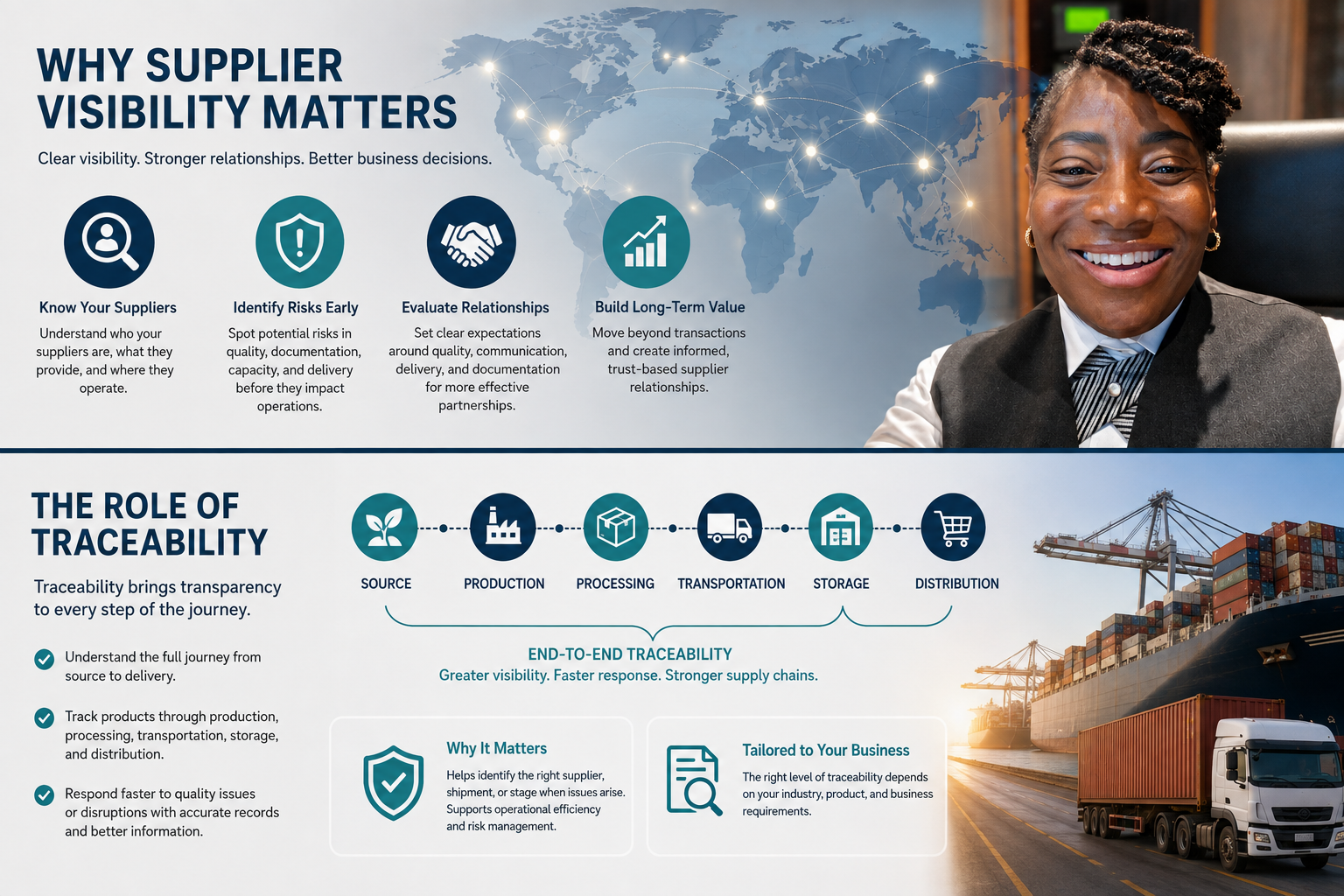
Supplier visibility is one of the foundations of a transparent supply chain. Businesses need to understand who their suppliers are, what they provide, where they operate, and whether they can consistently meet commercial requirements.
Without adequate supplier information, organizations may struggle to identify potential risks. Issues involving quality, documentation, production capacity, or delivery reliability can remain hidden until they affect operations. Better visibility allows companies to evaluate relationships more effectively. Businesses can establish clearer expectations around quality, communication, delivery, and documentation while maintaining a stronger understanding of supplier capabilities.
Supplier visibility also supports long-term relationship management. Instead of treating suppliers as anonymous sources of products, companies can develop a more informed view of the organizations supporting their operations.
The Role of Traceability
Traceability is closely connected with transparency. It helps businesses understand the journey of a product or material through different stages of the supply chain. For many organizations, traceability begins with the source and continues through production, processing, transportation, storage, and distribution.
The level of traceability required depends on the industry and product. Some businesses may need detailed information about individual batches, while others may focus on supplier records and broader product origins.
Effective traceability can help businesses respond more quickly when questions arise. If a quality issue or supply disruption occurs, better records can make it easier to identify the relevant supplier, shipment, or stage of the process. This can support both operational efficiency and risk management.
Transparency and Responsible Procurement
Responsible procurement depends on good information. Businesses cannot make informed sourcing decisions if they have limited visibility into their suppliers and supply networks. A transparent procurement process can include supplier evaluation, documentation review, quality expectations, communication procedures, and ongoing performance monitoring.
This does not mean every supplier needs to follow exactly the same process. Requirements should reflect the nature of the product, market, industry, and business relationship. However, organizations that establish clear sourcing standards can make procurement more consistent and easier to manage.
Transparency also helps businesses compare suppliers based on broader factors than price alone. Reliability, quality, communication, documentation, and long-term compatibility can all contribute to the overall value of a supplier relationship.
Technology and Supply Chain Visibility
Technology is playing an increasingly important role in improving supply-chain transparency. Digital systems can help businesses organize supplier information, monitor logistics, manage documentation, and analyze operational data.
Tracking platforms can provide information about shipments and delivery progress. Supplier-management systems can centralize important records. Data analytics can help organizations identify patterns and potential areas of concern. These tools can reduce the difficulty of managing information across complex supply networks.
However, technology should support rather than replace effective business processes. A digital system is only as useful as the information entered into it. Businesses still need accurate data, clear responsibilities, and reliable communication with their suppliers and partners. Technology can improve visibility, but people and processes make transparency meaningful.
Building Trust Through Transparency
Trust is an important part of international business relationships. Buyers want confidence that suppliers can meet expectations, while suppliers want confidence that buyers will communicate clearly and maintain professional relationships. Transparency can strengthen this trust by reducing uncertainty.
When businesses share relevant information and establish clear expectations, misunderstandings can be reduced. Partners can better understand requirements, responsibilities, and timelines. Over time, consistent transparency can contribute to stronger relationships.
This is particularly important in international trade because businesses may operate in different countries, time zones, regulatory environments, and cultural settings. Clear information provides a common foundation for collaboration.
Transparency and Supply Chain Resilience
Supply-chain resilience depends partly on how well a business understands its network. If an organization has limited visibility into its suppliers, it may struggle to understand how a disruption could affect operations. If a supplier experiences production difficulties or transportation delays, the impact may spread across several stages of the supply chain. Greater transparency can help businesses identify dependencies and potential vulnerabilities.
Organizations can use supplier information and operational data to understand where critical risks exist. They can then consider appropriate contingency plans, alternative sourcing options, or communication procedures Transparency does not prevent disruptions, but it can improve a company’s ability to recognize and respond to them.
The Human Side of Transparent Supply Chains
It is easy to think about supply-chain transparency as a technology issue, but the human side remains equally important. Strong communication between buyers, suppliers, logistics providers, and other partners is essential. People need to understand what information is required, why it matters, and how it should be maintained.
Relationships also influence the quality of information available within a supply network. A supplier that has a strong relationship with a buyer may be more willing to communicate challenges early. This can give both sides an opportunity to address problems before they become larger disruptions. For this reason, transparency and supplier relationships should be developed together.
Katrina Pierce and Modern Supply Networks
The professional perspective of Katrina Pierce fits within this broader movement toward greater transparency and responsibility in global sourcing. Her interests in sustainable sourcing, responsible procurement, supplier relationships, and international trade connect with the growing need for businesses to understand their supply networks more clearly.
Modern sourcing is increasingly about creating systems that connect commercial efficiency with responsible business practices. Better visibility can support stronger relationships, while stronger relationships can make it easier to maintain accurate information and respond to changes. This creates a cycle in which transparency, communication, and trust reinforce one another.
Creating Better Business Decisions
One of the most practical benefits of transparency is improved decision-making. Businesses make sourcing decisions based on information. If that information is incomplete or outdated, decisions may create unnecessary risks. Accurate supplier information can help companies evaluate potential partners. Product and quality information can support procurement planning. Logistics data can help businesses understand delivery performance. Better information does not guarantee perfect decisions, but it provides a stronger foundation for making them. This is especially valuable in global markets, where conditions can change quickly.
The Future of Transparent Global Trade
Global trade will continue to become more data-driven and interconnected. Businesses are likely to invest further in digital procurement, traceability systems, supplier-management platforms, and analytics. At the same time, expectations around responsible business practices will continue to influence sourcing strategies.
Future supply chains may therefore combine advanced technology with stronger human relationships. Digital systems can provide visibility, while suppliers and buyers provide the communication and collaboration necessary to use that information effectively. The organizations that adapt successfully will be those that treat transparency as an ongoing process rather than a one-time project.
A Long-Term Approach to Supply Chain Management
Transparency requires continuous attention. Supplier information can change, regulations can evolve, and market conditions can shift. Businesses therefore need processes for regularly reviewing and updating important information.
Long-term supply-chain management should include ongoing communication with suppliers, periodic performance reviews, appropriate documentation, and regular assessment of potential risks. This approach can help organizations maintain visibility even as their supply networks grow. It also supports a more strategic approach to procurement, where businesses consider both current requirements and future needs.
Katrina Pierce and Responsible Global Commerce
The work and professional interests of Katrina Pierce can be viewed within an international business environment where transparency and responsible sourcing are becoming increasingly important. Connecting suppliers and buyers requires more than commercial transactions; it requires communication, coordination, and an understanding of the systems supporting global trade.
As businesses continue to build international partnerships, these principles can contribute to more reliable and sustainable supply networks. Transparency can provide the information needed to understand those networks, while responsible sourcing can help organizations make thoughtful decisions about the relationships within them.
Looking Ahead
The future of global supply chains will depend on businesses being able to balance efficiency, transparency, responsibility, and adaptability. Companies that understand their suppliers and maintain reliable information can make better-informed decisions. Organizations that combine technology with strong communication can improve visibility without losing the human element of international trade.
Supply-chain transparency will therefore continue to develop alongside digital transformation and sustainable business practices. The objective is not simply to collect more information. It is to create useful visibility that supports better decisions, stronger partnerships, and greater resilience.
Conclusion
Supply-chain transparency has become an important part of modern global commerce. As international sourcing networks become more complex, businesses need reliable information about suppliers, products, logistics, and relationships. Greater visibility can support responsible procurement, improve supplier communication, strengthen risk management, and contribute to long-term supply-chain resilience.
The professional perspective of Katrina Pierce reflects this changing business environment, where sustainable sourcing, responsible procurement, supplier relationships, and transparent global trade are increasingly connected. The future of sourcing will not be defined by technology alone. Digital systems can provide valuable information, but successful supply chains will continue to depend on communication, trust, accountability, and collaboration.
Businesses that make transparency part of their long-term strategy can build a clearer understanding of their supply networks and become better prepared for changing market conditions. Ultimately, a transparent supply chain is not simply a collection of data. It is a connected business environment where suppliers, buyers, and partners have the information and relationships needed to work together effectively.
Katrina Pierce represents a professional direction aligned with this evolving approach to global commerce — one that places greater value on responsible sourcing, transparent relationships, and sustainable long-term business development.